
You’re looking at two heat pumps. Same brand with the same cooling power, but one costs $3,000 more.
The sales guy keeps saying “Hyper Heat” like it’s a magic word. Your neighbor swears by their standard model. Google shows you forum fights about which one’s better.
I’m Ray, and I’ve installed both types all over Greater Boston, and nobody is telling you the complete truth: the question isn’t which system is better. The question is which system matches how you’re actually heating your house.
Not all heat pumps work the same when temperatures drop. Some keep pumping out heat when it’s 5 degrees outside. Others start struggling at 25 degrees. The difference becomes your living room feeling warm or feeling like you need a sweater indoors.
Your job isn’t figuring out which technology sounds more impressive. Your job is understanding what happens to these systems in real Massachusetts weather, then deciding which one fits your situation.
Should you spend the extra money for Hyper Heat, or is a standard model enough?
Let me show you exactly what changes when temperatures drop, why it happens, and how to know which system you actually need.
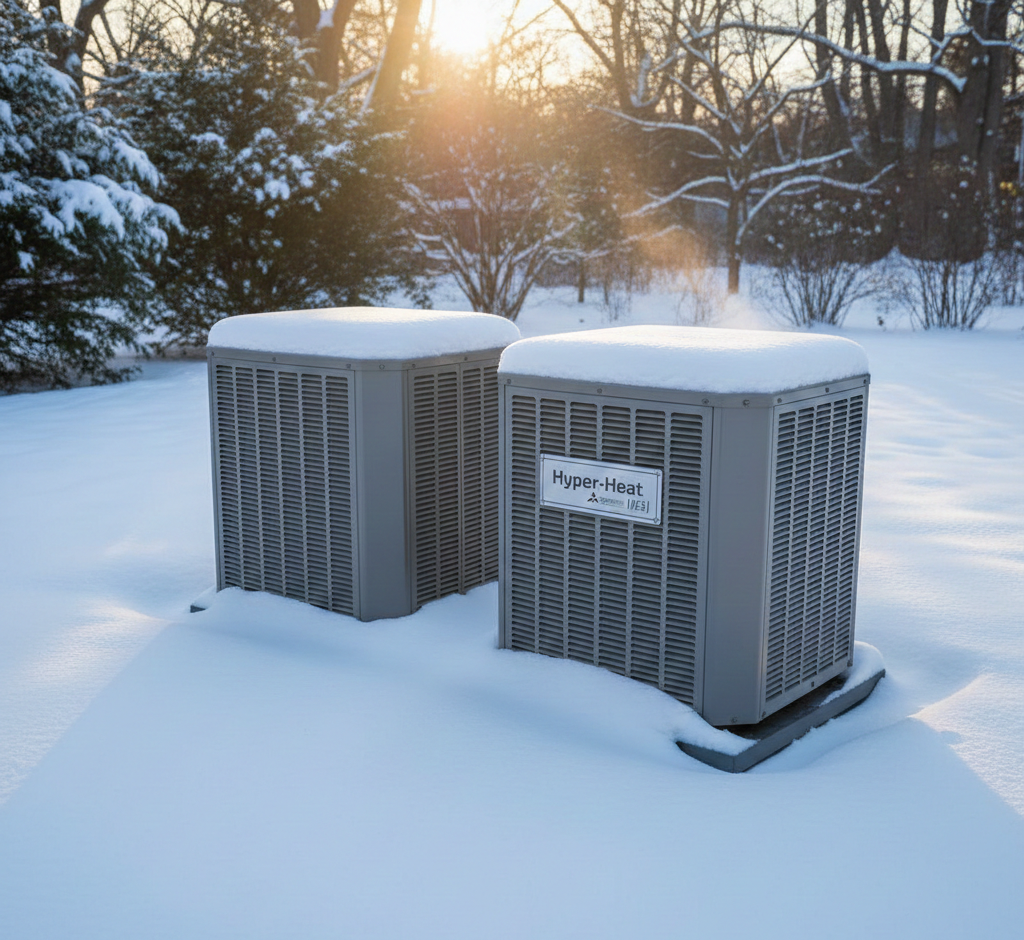
What Is the Difference? (Standard vs. Hyper Heat)
Both systems move heat instead of creating it. That’s the fundamental difference between heat pumps and furnaces.
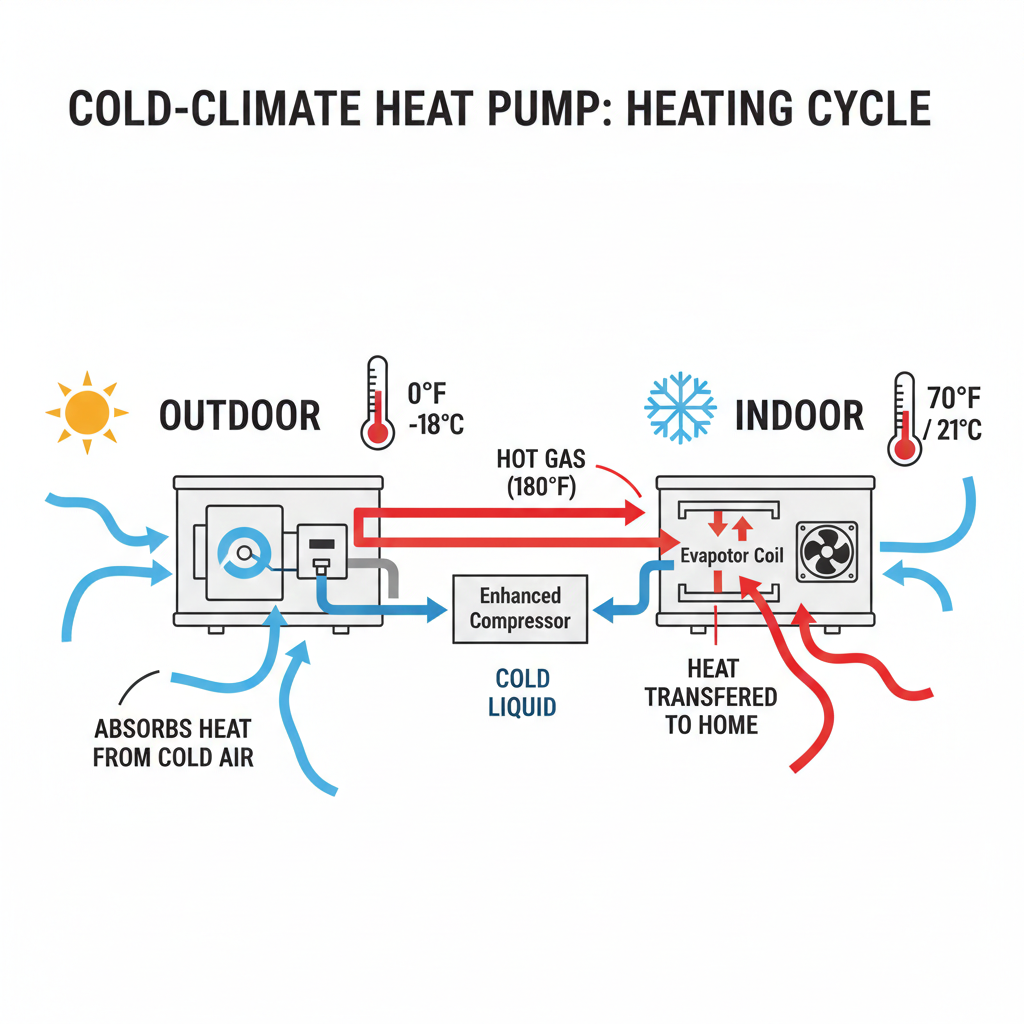
Your oil furnace burns fuel to generate heat. A heat pump just moves existing heat from outside to inside. Even when it’s 20 degrees outside, there’s still heat energy in that air. Heat pumps capture it and bring it indoors.
This is why heat pumps are so efficient. Moving heat takes way less energy than creating it from scratch.
But here’s where standard heat pumps and Hyper Heat start diverging.
How Standard Heat Pumps Work (And Why They Struggle in Cold)
Inside every heat pump is a substance called refrigerant. Think of it like the blood in your circulatory system. It flows in a continuous loop, carrying heat from outside to inside.
The refrigerant starts as a cold liquid outside your house. Even at 30 degrees, outdoor air is warmer than this liquid refrigerant (which sits around -15°F). Heat naturally flows from warmer to cooler, so the refrigerant absorbs warmth from the outdoor air and starts turning into a gas.
That gas gets compressed, which makes it hot. Really hot. Hotter than your indoor air. It flows inside, releases that heat into your house, cools back down to liquid, and heads outside to repeat the cycle.
This works beautifully in spring and fall. Even in winter when it’s 35 degrees outside, standard heat pumps run great.
The problem shows up when temperatures keep dropping.
Refrigerant doesn’t flow as easily in extreme cold. The compressor has to work harder to move it through the system. Pressure builds up differently. The whole process slows down.
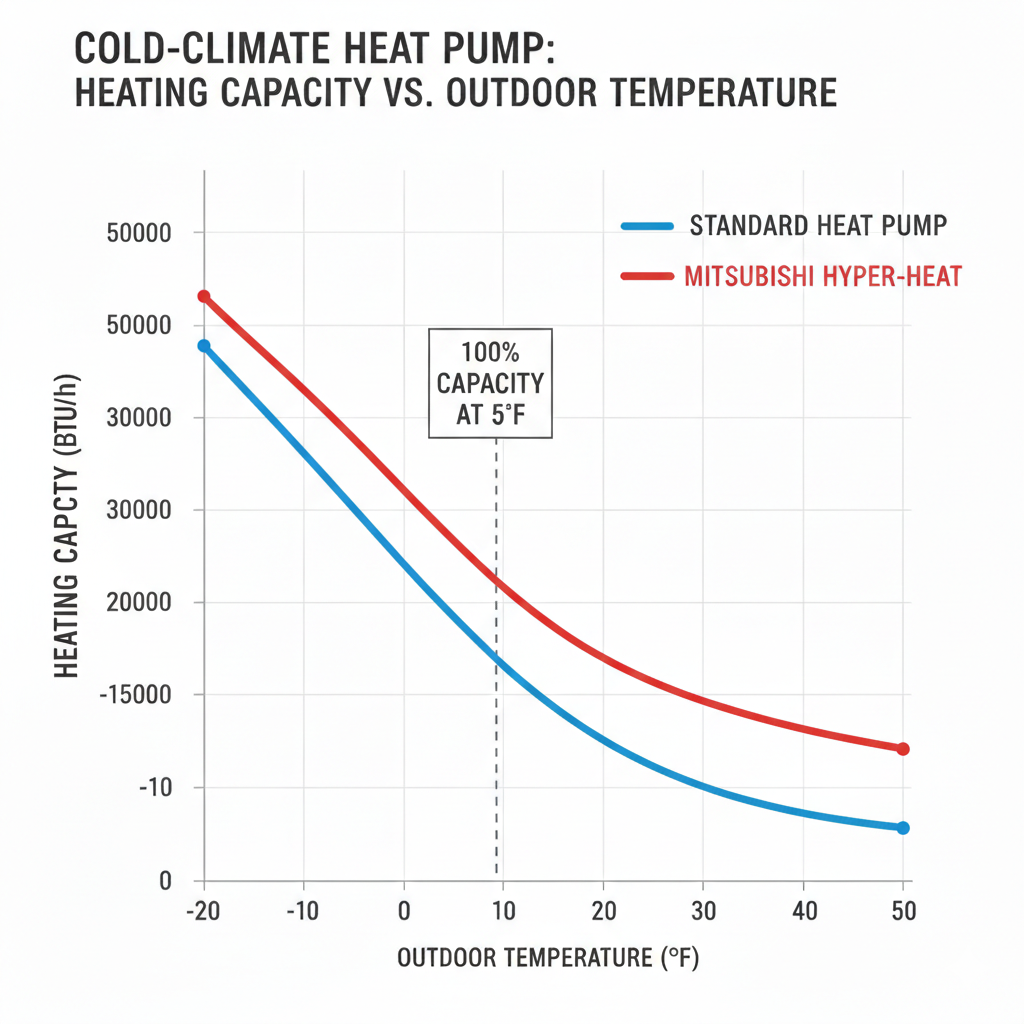
At 47°F outside, a standard 24,000 BTU heat pump might actually produce 30,600 BTUs. Over-performing.
At 5°F outside, that same unit drops to 19,000 BTUs. Under-performing by 21%.
Your house needs the same amount of heat. Actually, it needs more heat because it’s colder outside. But your heat pump is producing less.
This is why people in cold climates used to say “heat pumps don’t work in winter.” Old heat pumps really didn’t. They’d give up around 30 degrees and you’d be running backup heat constantly.
How Hyper Heat Solves This (The Engineering Behind It)
Mitsubishi looked at this problem and redesigned how the system handles cold weather.
They upgraded the compressor to run at higher speeds when temperatures drop. Instead of slowing down in the cold, it can speed up to compensate.
They modified the refrigerant circuit to maintain proper pressure even in extreme temperatures. The flow stays consistent instead of getting sluggish.
They added a base pan heater that prevents ice from forming on the outdoor unit. Standard units can freeze up and shut down temporarily for defrost cycles. Hyper Heat minimizes this.
The result? Hyper-Heating systems can perform at 100 percent of rated capacity in outdoor ambient temperatures as low as 5°F with guaranteed operation down to -13°F.
That same 24,000 BTU system? At 5°F outside, Hyper Heat is still putting out 25,000 BTUs. Full capacity maintained.
Think about what this means practically. On a cold January night when your standard heat pump is limping along at 79% capacity, Hyper Heat is still running at full strength. You’re not making up the difference with expensive backup heat. Your living room stays 72 degrees without the system struggling.
Standard heat pumps are designed for moderate climates. Places where “winter” means 45 degrees.
Hyper Heat is designed specifically for places like Massachusetts, where winter actually gets cold and stays cold for extended periods.
Both move heat. One just does it way better when the temperature drops below freezing.
Performance in Boston Weather
Now I am going to show you what actually happens to both systems as temperatures drop through a typical Massachusetts winter.
I’m using a 24,000 BTU unit because that’s what most 1,500 square foot homes need. These numbers come from Mitsubishi’s own performance data.
| Standard Heat Pump Performance: | Hyper Heat Performance: |
| At 47°F: Producing 30,600 BTUs (running 28% above rated capacity, super efficient)At 32°F: Still working well, efficiency starting to declineAt 17°F: Noticeable capacity loss, compressor working harderAt 5°F: Only putting out 19,000 BTUs (5,000 BTUs short of what you paid for)Below 0°F: Capacity drops even further, backup heat running constantly. | At 47°F: Producing 30,600 BTUs (identical to standard model)At 32°F: Still at full capacity, no declineAt 17°F: Maintaining rated outputAt 5°F: Still delivering 25,000 BTUs (actually exceeding rated capacity)At -13°F: Operating at 74% capacity (still heating your house effectively) |
See what’s happening here?
Above 35 degrees, both systems perform identically. You wouldn’t know which one you have. They’re equally efficient, equally effective.
The difference shows up in the mid-20s and gets dramatic once you hit single digits.
What This Actually Feels Like in Your House
Let’s make this concrete. You’re sitting in your living room on a January night. Outside temperature is 8 degrees.
Your house needs about 24,000 BTUs per hour to maintain 70 degrees inside.
With a standard heat pump: Your system is producing maybe 20,000 BTUs. You’re 4,000 BTUs short. The house slowly cools down to 67, then 65. Your backup heat kicks in to make up the difference. If you don’t have backup heat, you’re putting on a sweater.
With Hyper Heat: Your system is producing 25,000 BTUs. More than enough. The house stays 70 degrees. System cycles on and off normally. You don’t even think about it.
This isn’t theoretical. Last winter, Boston experienced the coldest periods in mid- to late December and early and late January. Multiple nights dropped into single digits. Some mornings were below zero.
Those are the nights that separate these two systems.
A standard heat pump on those nights is working as hard as it can but losing the battle against the cold. Hyper Heat is still running strong like it’s a 40-degree day in November.
Does This Mean Standard Heat Pumps Are Bad?
No. Absolutely not.
It means they work best when you have backup heat to cover the coldest stretches. If you’re keeping your existing gas furnace or oil boiler for those 10-15 really cold days per winter, a standard model handles everything else beautifully.
But if you’re trying to heat entirely with electricity and you don’t have backup, Hyper Heat becomes critical. Because on those single-digit nights, a standard unit without backup means your house gets cold.
Temperature Performance Comparison
| At 47°F (Mild Winter Day): Standard: 30,600 BTUs ✓ Hyper Heat: 30,600 BTUs ✓ Winner: Tie | At 17°F (Cold Winter Night): Standard: ~22,000 BTUs Hyper Heat: 24,000+ BTUs ✓ Winner: Hyper Heat | At 5°F (Very Cold Snap): Standard: 19,000 BTUs Hyper Heat: 25,000 BTUs ✓✓ Winner: Hyper Heat (by a lot) |
Is the Extra Cost Worth It?
Hyper Heat costs more. Usually $2,000 to $4,000 more depending on your system size.
That’s real money. So when does it actually make sense to spend it?
You Need Hyper Heat If:
You’re eliminating fossil fuel heating completely. No oil tank, No gas furnace, and all-electric home.
I see this constantly with people adding solar panels who want everything running on electricity. Or families sick of $5,000 annual oil bills. If the heat pump is your only heat source, you absolutely need it to work in January.
A standard heat pump trying to be your sole heat source on a 5-degree night is like asking a sedan to plow snow. Technically possible, but not what it was designed for. You’ll be miserable.
Hyper Heat is specifically engineered for this
It’s designed to be your primary and only heat source even in Massachusetts winters.
- Your house has no backup heating system. Maybe you’re currently heating with electric baseboard that’s getting ripped out entirely. Or your old furnace died and you’re not replacing it.
Without backup heat, you need a system that keeps working no matter what the thermometer says. That’s Hyper Heat.
- You want maximum comfort regardless of outdoor temperature. Some people just hate being cold. If that’s you, and you don’t want to wonder whether your system can keep up during a polar vortex, Hyper Heat gives you peace of mind.
You’re paying for the confidence that your house stays 70 degrees whether it’s 40 outside or -5 outside.
- You’re keeping this system long-term (15-20 years). Heat pumps last. If you’re planning to own this house for decades, the extra investment pays off in consistent performance year after year.
Spread that $3,000 over 20 years and you’re talking $150 annually for significantly better cold-weather performance.
You Don’t Need Hyper Heat If:
- You’re keeping your gas furnace or oil boiler as backup.
This is the big one.
If your furnace is staying in place and you’re comfortable using it for the coldest 10-15 days of winter, save your money. A standard heat pump will cover 85-90% of your heating season beautifully. The furnace automatically handles the rest.
I install this setup all the time. People want to reduce oil consumption and save money, but they’re not ready to go all-electric. Standard heat pump plus existing furnace backup works great.
- You’re installing primarily for air conditioning.
Maybe you just want to eliminate window units and winter heating is a nice bonus but not the main goal.
Standard models cool just as well as Hyper Heat. Identical performance in summer. If cooling is your priority and heating is secondary, don’t overspend.
- Budget is a real constraint.
Not everyone has an extra $3,000 available. I get it.
Standard heat pumps still deliver excellent efficiency for 80% of the heating season. They’re a massive upgrade over electric baseboard or old inefficient furnaces. If the price difference is prohibitive, standard is still a solid choice.
- Your home has excellent insulation and air sealing.
Really tight, well-insulated houses lose heat much slower.
Less heat loss means less demand on the system overall. In a super-efficient home, even a standard heat pump might keep up fine during cold snaps because the house isn’t bleeding heat.
The Honest Truth About Which One to Get
I install both types regularly. The contractors who won’t have this conversation with you are trying to maximize their commission.
At VivaVolt, I’m not pushing Hyper Heat on you if you’ve got a functioning gas furnace you’re planning to keep. That’s your money I’m wasting.
But if you call me saying you want to pull out your oil tank and go all-electric, I’m recommending Hyper Heat every time. I’ve seen what happens when people try heating a Massachusetts home in January with only a standard heat pump. It doesn’t end well.
| Get Hyper Heat If: ✓ No backup heating system ✓ Going all-electric ✓ Want guaranteed comfort at any temperature ✓ Planning to keep system 15+ years | Standard Works If: ✓ Keeping gas/oil furnace as backup ✓ Primarily want air conditioning ✓ Budget-conscious ✓ Well-insulated home |

Bottom Line
Heat pump technology has advanced dramatically. Even standard models today outperform the best systems from just five years ago.
But Massachusetts winters haven’t changed. We still get weeks in the 20s. Multi-day stretches in single digits. Occasional nights below zero.
Modern technology means you don’t have to hide under blankets in the middle of winter anymore. But you need to choose the right tool for the job.
Hyper Heat is engineered for cold climates. It’s designed to be your primary heat source even when it’s brutally cold outside. If that’s your situation, it’s worth every penny of the premium.
Standard heat pumps work great with backup heating. They’re efficient, effective, and significantly cheaper. If you’re keeping your furnace, they’re the smarter choice.
Don’t overspend on features you don’t need just because a sales guy made them sound essential. And definitely don’t under-buy and freeze because you tried saving money on equipment designed for a different climate.
If you’re in Greater Boston and want honest advice about Mitsubishi Hyper Heat vs standard heat pump for Boston winters, call me at VivaVolt: 781-908-2200.
I’ll look at your current heating setup, ask whether you’re keeping backup heat, and tell you straight which system makes sense.
No upselling equipment you don’t need. No pushing cheap systems that won’t keep you warm. Just honest guidance about what actually works for your house.
FAQs
I have a gas furnace already. Do I really need to spend extra for Hyper Heat?
No. Save your money. If your furnace is staying and you’re comfortable using it for the coldest days, a standard heat pump handles 90% of the heating season beautifully. The furnace covers the rest automatically.
How much more does Hyper Heat cost to operate monthly?
In moderate temperatures (above 32°F), electricity costs are nearly identical. In extreme cold, Hyper Heat actually costs less to run because it maintains efficiency without relying on backup electric resistance heat, which is expensive. You’re getting more heat per dollar of electricity.
Will a standard unit just stop working when it gets really cold?
No. It keeps running down to around 0°F. But its heating capacity drops significantly. It doesn’t quit, it just produces way less heat exactly when you need it most. That’s when backup heat has to kick in to make up the difference.
Can I upgrade from standard to Hyper Heat later if I change my mind?
Unfortunately no. You’d have to replace the entire outdoor unit, which means buying a new system. The compressor and refrigerant circuit are fundamentally different. This is a decision you make at installation and live with for 15-20 years.
How long do these systems last in Massachusetts winters?
Both standard and Hyper Heat last 15-20 years with annual maintenance. They have similar lifespans. The difference isn’t longevity, it’s performance during those years. Hyper Heat keeps working at full capacity in cold weather. Standard doesn’t.
Is Hyper Heat significantly louder than standard models?
Slightly. The more powerful compressor and higher-speed components needed for cold-weather performance add maybe 2-3 decibels. Most people don’t notice the difference. It’s quieter than a window AC unit either way.