
Your house doesn’t have ductwork. Maybe it’s a 1920s Colonial in Newton with beautiful plaster walls and radiator heat.
Maybe it’s a 1960s ranch in Quincy that was built with electric baseboard. Maybe it’s a triple-decker in Dorchester that’s been in your family for generations.
Different houses, different decades, and the same problem: no central air. And every contractor you’ve talked to says adding it means tearing your house apart.
So you’ve been living with window AC units that block your views and sound like jet engines. Or you’ve been sweating through July and August because you can’t bring yourself to ruin your walls just to install ductwork.
Walk through any Massachusetts neighborhood and you’ll see the same thing. Homes built in every decade from the 1880s through the 1980s, most of them never designed for central air conditioning. They’ve got charm, character, and solid construction. They just don’t have ducts.
Turns out, you don’t need them. Here is exactly how you can upgrade your home without the mess.

Why Heat Pumps are Perfect for Old Houses (No Ducts Needed)
Think about how your house was originally built.
Radiators and a boiler in the basement, electric baseboard heaters along the walls, or maybe an old oil furnace with those big clunky registers. Whatever heating you have, it wasn’t designed around ductwork.
Adding central air now means building a whole duct system from scratch. Contractors have to create pathways through your walls, drop bulkheads from ceilings to hide the ducts, carve out closet space for vertical runs.
It’s invasive, it’s expensive, and it fundamentally changes your living space.
Heat pumps for old houses with no ductwork work completely differently.
One small hole in your exterior wall, three inches across, and that’s it.
Through that hole runs a refrigerant line connecting an outdoor unit to an indoor unit. The outdoor compressor sits on a pad next to your house (or mounts on brackets if you don’t have ground space). The indoor unit mounts wherever it makes sense in the room.
You’re not ripping into walls. You’re not building bulkheads. You’re not losing closet space. You’re not dealing with weeks of construction.
Most installations finish in a single day. You wake up with window AC units or no cooling at all. You go to bed with modern heating and cooling throughout your house.
The system only requires a three-inch penetration to connect indoor and outdoor equipment. Everything else stays intact. Your plaster walls, your crown moulding, your closets, your ceilings. Untouched.
This is why ductless mini-splits have become the go-to solution for older Massachusetts homes. They were essentially invented to solve this exact problem.
| [STAT BOX:] What Installation Actually Requires:Hole size: 3 inches (about a coffee can)Typical installation time: 4-8 hoursWall/ceiling damage: NonePlaster repair needed: NoneCloset space lost: 0 square feet |
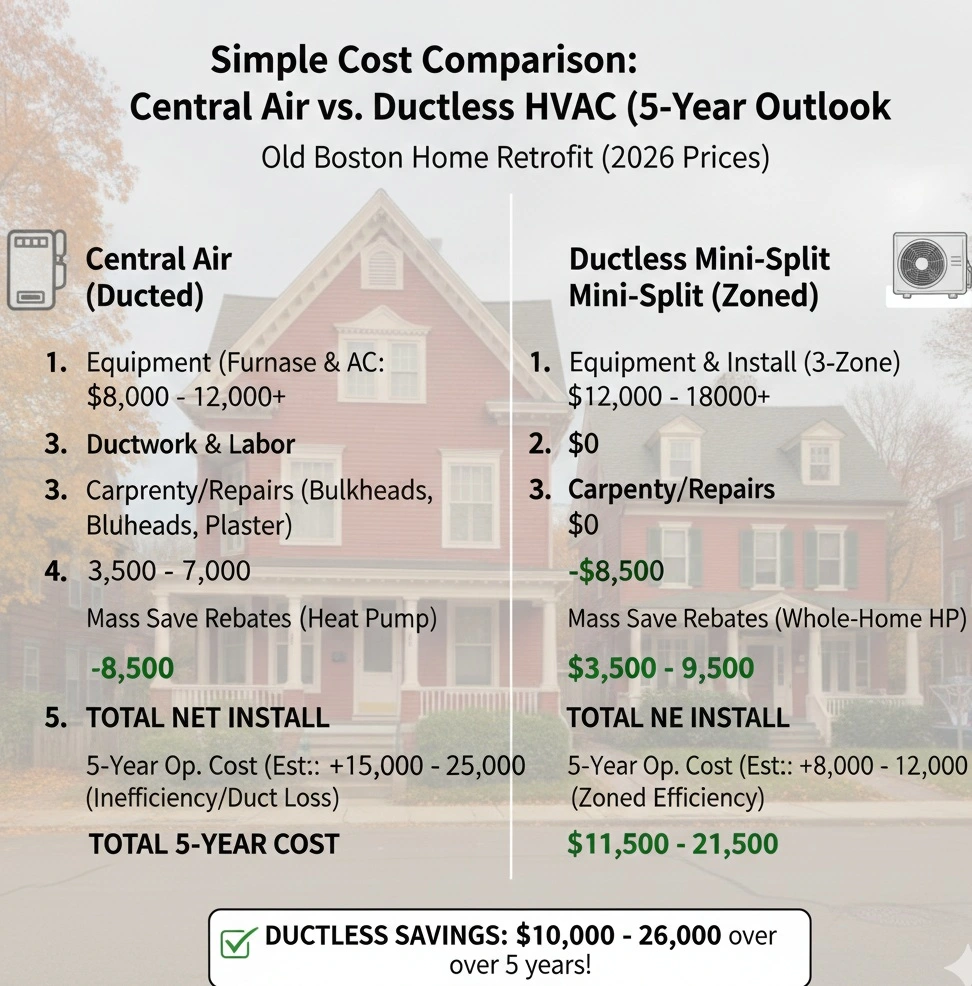
Ductless vs. Central Air Cost in MA
Let’s talk about what installing central air in old house Boston actually costs when you don’t have existing ductwork.
The equipment itself (furnace and AC unit) runs maybe $8,000-$12,000.Somewhat reasonable.
But then you need ductwork. Fabricating and installing a complete duct system for a 1,500-square-foot house adds another $8,000 to $12,000. Sometimes more if your house layout is complicated.
You’ll probably need bulkheads built to hide the ducts. That’s framing, drywall, painting. Add $2,000-$4,000.
If you’ve got plaster walls, expect repairs. Cutting access points, patching, matching textures. Another $1,500-$3,000.
Total for central air retrofit: $20,000-$30,000. Sometimes higher.
Installation takes one to two weeks. Your house is a construction zone. Dust everywhere. Contractors in and out daily. If you work from home or have young kids, it’s miserable.
The ductless mini split vs. central air cost in MA
A three-zone system covering main living areas and bedrooms runs $12,000-$18,000 installed. Everything included. No hidden costs for ductwork because there isn’t any, no bulkheads, and no plaster repair.
Installation happens in a day. Minimal disruption.
But the real cost difference shows up in how the systems actually operate.
Central air controlled by one thermostat means you’re heating or cooling your entire house at once. That guest bedroom nobody uses? Gets conditioned anyway. That finished basement you only use on weekends? Running constantly, whether you’re down there or not.
Ductless systems give you zoned control. Each indoor unit operates independently. You heat and cool only the spaces you’re actually using.
In older Massachusetts homes without great insulation, this matters tremendously. You’re not wasting energy conditioning spaces that don’t need it.
Duct loss adds another 20-30% to your energy bills with central air. Conditioned air leaks through joints, seams, and connections in the ductwork before it ever reaches your rooms. The Department of Energy has documented this for years.
Ductless systems have no ducts to leak. The efficiency you’re paying for actually makes it to your living space.
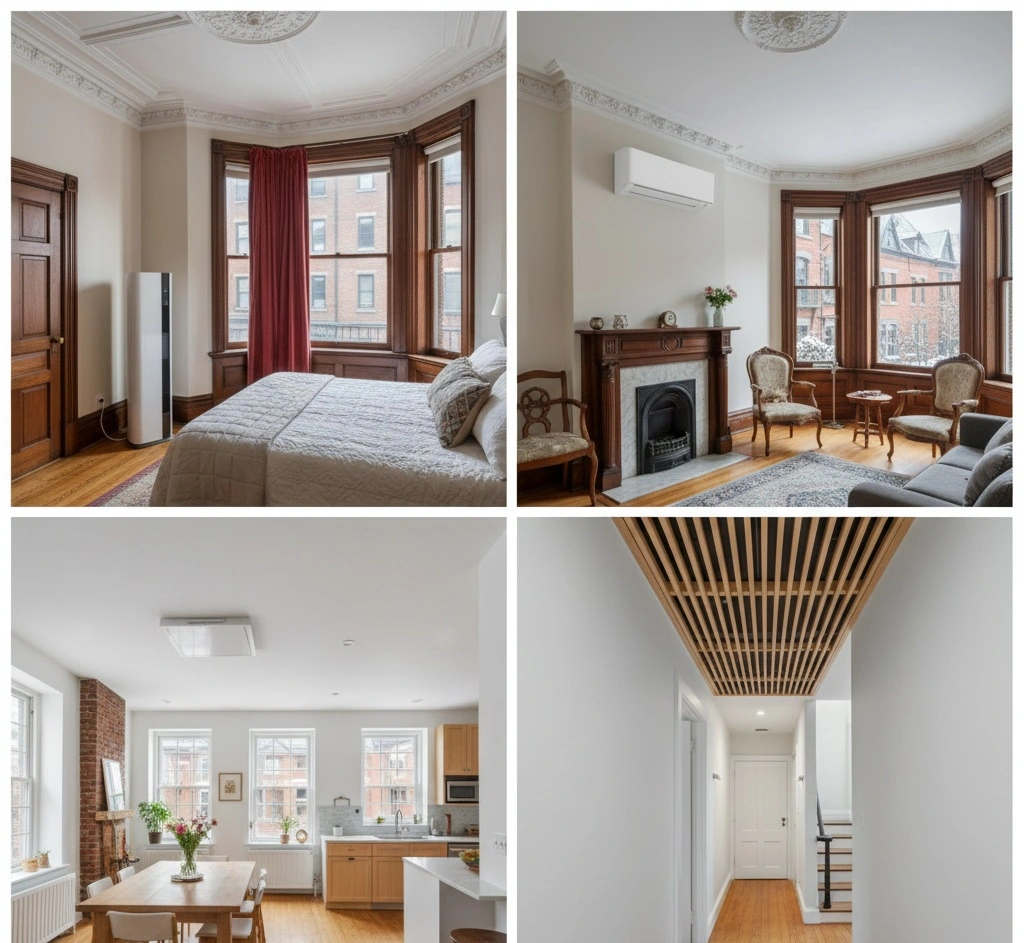
“I Don’t Want an Ugly Box on My Wall” – Design Options
You’re picturing that standard white plastic box mounted high on the wall. The kind you see in hotel rooms or older office buildings.
Floor mounted vs wall mounted heat pumps is a question most people don’t realize they get to ask. You have actual choices about how these systems look in your home.
Floor-mounted units sit low on the wall, about where old radiators used to be.
- Six inches off the floor.
- They’re sleek, low-profile, and tend to blend into the baseboard area.
- Great for rooms with lots of windows, elaborate crown molding, or anywhere you don’t have clear wall space up high.
These work particularly well in rooms with sloped ceilings or architectural details you want to preserve; sunrooms, converted attics, etc. Anywhere a wall-mounted unit would compete visually with existing features.
Wall-mounted units have evolved dramatically.
- Modern designs look intentional rather than industrial.
- Some manufacturers make mirror-finish models that look like modern art.
- Others offer white, black, or silver finishes that blend into different aesthetics.
Mount them high near the ceiling where they’re less visually prominent. Position them above furniture or in corners where they’re not the focal point of the room.
Ceiling cassettes flush-mount into your ceiling, looking similar to a recessed light fixture. Four vents distribute air in all directions. You barely notice them once installed.
- These work beautifully in open-concept spaces or rooms where wall space is at a premium. Kitchens with lots of cabinetry.
- Living rooms with windows on multiple walls.
- Anywhere you need climate control, but don’t have an obvious spot for a wall unit.
Concealed duct units hide completely in closets or ceiling spaces. Only small vents show in your ceiling. You get modern climate control with zero visible indoor equipment.
You can mix and match throughout your house based on each room’s specific needs and layout.
Different rooms, different solutions because it’s your house, your aesthetic choices.
Bonus Benefit: Air Quality & Dehumidification
Older Massachusetts homes tend to feel damp.
- Basements with questionable waterproofing.
- Bathrooms with minimal ventilation.
- Kitchens where the range hood vents back into the room rather than outside.
All of that moisture has nowhere to go.
You probably notice it most in summer. That muggy, heavy feeling. Condensation on windows. That slight musty smell that you’ve gotten used to but visitors notice immediately.
Heat pumps actively remove humidity as part of their normal cooling operation. It’s not a separate feature you turn on. It’s built into how the system works.
As warm, humid air passes over the cold indoor coil, moisture condenses out. The system drains it away. The air that comes back into your room is drier and more comfortable.
People notice the difference within days. Your house feels fresher. That heavy, damp feeling disappears, and windows stop fogging up.
Every indoor unit also filters the air continuously. Multi-stage filters catch dust, pollen, pet dander, and other airborne particles. In fact, some models include ionizers that further improve air quality.
This matters more than you’d think in older homes. Years of accumulated dust in wall cavities. Pollen that gets tracked in through leaky windows. Cooking odors that linger because ventilation is inadequate.
The constant filtration and air circulation creates noticeably cleaner indoor air. People with allergies or respiratory issues often see improvements within weeks.
If you’re currently heating with oil or gas, switching to electric heat also eliminates combustion byproducts from your living space. No more nitrogen oxides, no particulate matter, and absolutely no low-level carbon monoxide exposure.
You’re getting temperature control and simultaneously improving the air your family breathes every day.
Conclusion
You can give your house modern comfort without destroying what makes it special.
Whether you’ve got a Victorian that’s stood for 130 years, a mid-century ranch from the 1960s, or a Colonial that’s been in your family for generations, the solution is the same: heat pumps for old houses with no ductwork.
One three-inch hole per indoor unit. Installation in a day. Zero damage to walls, ceilings, or closets. Modern heating and cooling that respects the structure you’re trying to preserve.
Your house has already survived decades or centuries without central air. It can survive another century with the right system installed the right way.
If you’re in Greater Boston and want to talk about whether ductless makes sense for your specific house, give us a call at VivaVolt: 781-908-2200.
We’ll look at your home, listen to how you use the space, and tell you honestly whether this is the right solution.
Because preserving your home’s character while making it comfortable shouldn’t require choosing one over the other.

FAQs
Do heat pumps for old houses with no ductwork work in Massachusetts winters?
Modern cold-climate systems maintain full heating capacity down to -13°F and continue operating to -30°F. Massachusetts rarely hits those temperatures. The question is whether your house has adequate insulation, which affects any heating system.
How does installing central air in old house Boston compare to ductless?
Central air retrofit: $20K-$30K+, 1-2 weeks installation, requires ductwork construction, bulkheads, wall repairs. Ductless: $12K-$18K, one-day install, one 3-inch hole per unit, zero structural changes.
When comparing floor mounted vs wall mounted heat pumps, which is better?
Floor units work great in rooms with limited wall space, lots of windows, or sloped ceilings. Wall units are slightly more efficient because they’re higher up, distributing air better. Choose based on your room layout and what looks right to you.
Will this damage my old plaster walls?
No. The three-inch hole gets drilled cleanly and sealed properly around the refrigerant lines. No cracking, no extensive repairs needed.
How many zones do I actually need?
Most Massachusetts homes need 2-4 zones depending on size and layout. Living areas and bedrooms typically get their own zones. Spaces you rarely use don’t need conditioning.
What about maintenance?
Filter cleaning every month or two (takes 30 seconds). Professional service once a year. That’s it. Less maintenance than a traditional furnace and AC system combined.